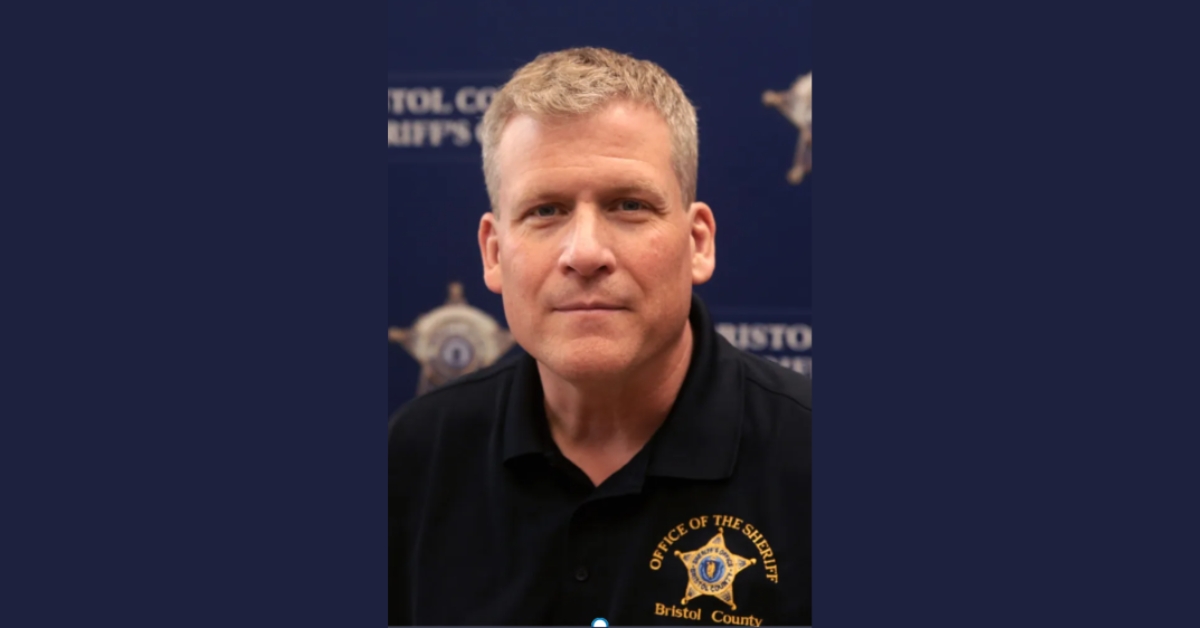
DARTMOUTH — The Bristol County Sheriff’s Office will not participate in federal immigration enforcement or enter into agreements with U.S. Immigration and Customs Enforcement, Sheriff Paul Heroux announced in a policy statement released Wednesday.
In the release, Heroux said he updated the office’s information-sharing and cooperation policy in November 2025 and outlined several reasons why the department will not expand its involvement with U.S. Immigration and Customs Enforcement.
He noted that, under current law, local sheriffs do not have authority to enforce federal immigration statutes on their own unless they enter a specific federal partnership known as a 287(g) agreement. Section 287(g) of the Immigration and Nationality Act authorizes the Department of Homeland Security to deputize selected state and local law enforcement officers to carry out certain federal immigration enforcement functions under the supervision of U.S. Immigration and Customs Enforcement (ICE), including determining immigration status and initiating removal proceedings, but only after the agency and local jurisdiction sign a formal memorandum of agreement and officers receive federal training.
Heroux then referenced two court decisions that define the limits of local law enforcement authority in immigration operations. In Arizona v. United States (2012), the U.S. Supreme Court struck down several provisions of an Arizona law that would have allowed state officers to carry out federal immigration enforcement, ruling that immigration authority rests primarily with the federal government.
He also cited Lunn v. Commonwealth (2017), a decision by the Massachusetts Supreme Judicial Court, which held that Massachusetts law does not authorize local or state law enforcement officers to arrest or detain individuals solely based on a federal immigration detainer. That ruling clarified that, without specific federal authorization through a program such as a 287(g) agreement, local agencies in Massachusetts lack the legal authority to hold someone for civil immigration enforcement purposes.
“In the absence of a 287(g) contract, Sheriffs cannot enforce federal immigration law per Arizona v. United States (2012) and Lunn v. Commonwealth (2017),” Heroux said. “The BCSO does not do any federal immigration enforcement. We are not going to enter into a 287(g) contract.”
Heroux said his decision is also driven by staffing shortages and concerns about potential legal exposure for his department.
“When it comes to assisting ICE, we are short-staffed and officers are frequently forced to do overtime. We do not hold anyone solely based on immigration status in accordance with Lunn. We are not going to enter into a 287(g) contract,” Heroux said. “Even if the BCSO had the staffing levels to assist, DHS does not offer automatic indemnification in the standard 287(g) contract. This exposes any organization with a 287(g) contract to legal liability.”
Heroux referenced a prior lawsuit involving the jail under the leadership of his predecessor, Republican Thomas Hodgson, which he said was settled in 2025 for $800,000 after allegations of civil rights violations connected to immigration-related detention. Heroux said the federal government did not provide legal or financial assistance in that case.
“For example, this jail lost its 287(g) contract in May of 2021 under my predecessor,” Heroux said in the release. “In April of 2022, my predecessor and this jail was sued for $10 million for alleged civil rights violations that happened in May 2020. I assumed office in January 2023, and when my office contacted DHS about this lawsuit, DHS essentially said ‘you’re on your own’ and offered no legal or financial assistance. In October 2025, I settled this lawsuit for $800,000, which is what it would have cost to pay legal fees going to trial regardless of the outcome.”
Heroux added that every law enforcement organization and government jurisdiction that has a 287(g) contract should be aware of this exposure to legal liability.
In Section 3 of his release titled “Concerning offering ICE assistance on the street,” Heroux said his POST-certified deputies have been instructed not to participate in street-level enforcement operations with ICE.
“BCSO Deputy Sheriffs who are POST-certified have been instructed to not assist ICE with any enforcement activity, and for good reason,” Heroux said. “The reason is if we assist ICE on a voluntary basis and ICE hurts someone or violates someone’s civil rights (as they have seemingly been doing all over the country) we can end up as a codefendant. I’m not risking my organization’s staff being sued (again).”
The sheriff said his office will provide ICE only the information required under public records laws and will not interfere with ICE operations.
“If we assist ICE on a voluntary basis and ICE hurts someone or violates someone’s civil rights (as they have seemingly been doing all over the country), we can end up as a codefendant,” Heroux explained.
He urged residents not to interfere with ICE operations but said those who believe they are witness to excessive force should document the incident rather than intervene.
“The BCSO will not interfere with ICE operations,” Heroux said. “Also, citizens should never interfere with any ICE operations or any law enforcement operations. If someone sees what appears to be excessive force or the violation of constitutional rights, record it and circulate it, but do not interfere.”
Heroux said he has no issue working with federal agencies such as the FBI or Drug Enforcement Administration (DEA) but criticized leadership within the Department of Homeland Security and the White House for defending agents accused of excessive force before investigations are completed. He said such actions undermine public trust in law enforcement.
“If ICE continues to appear to violate civil rights and engage in excessive force all over the country,” Heroux said, “I’m not interested in being associated with any of that. Law enforcement cannot break the law to enforce the law.