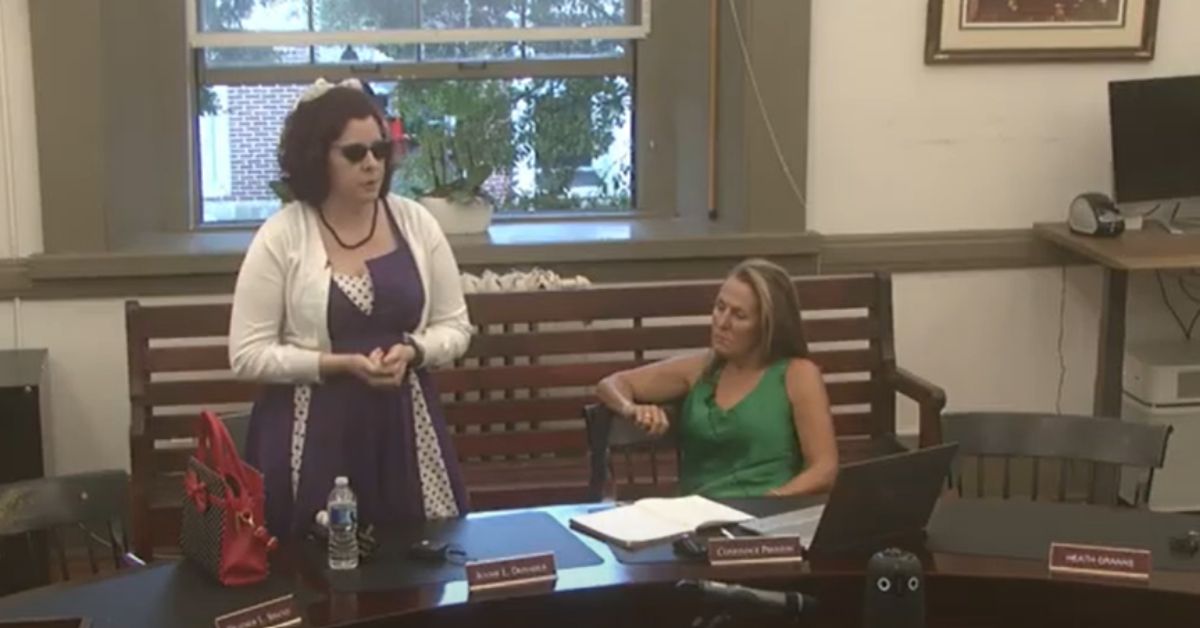
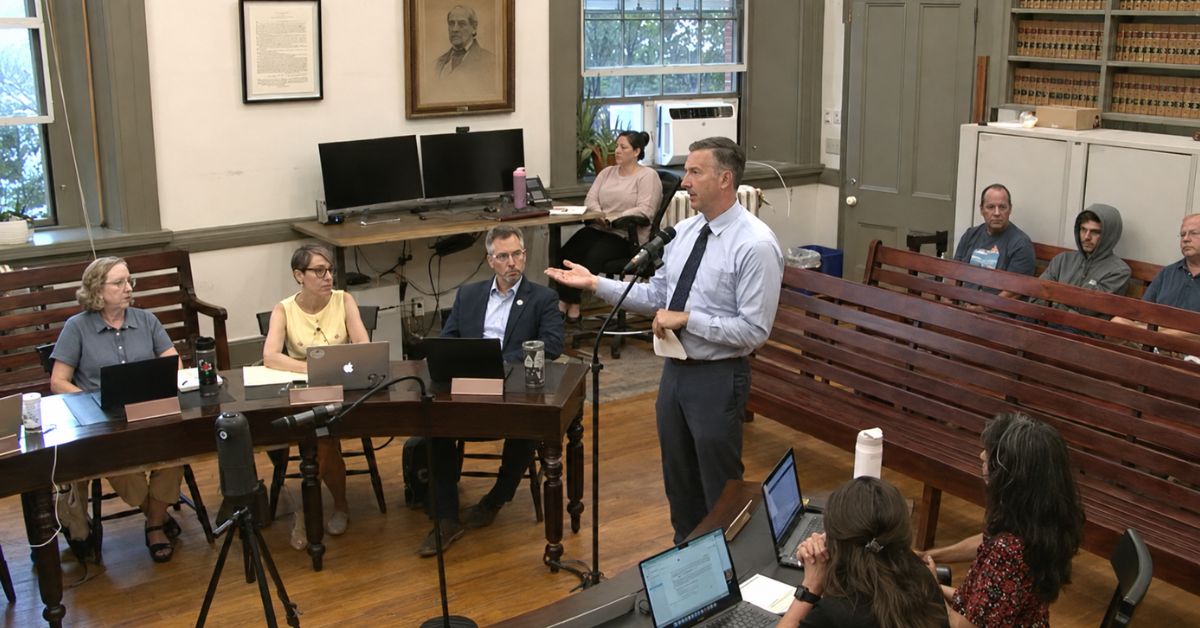
NEWBURYPORT — The Newburyport Zoning Board of Appeals spent much of its Nov. 12 meeting taking testimony on a proposed 212-unit Chapter 40B apartment complex at the former Kmart site in Port Plaza, hearing detailed traffic projections from residents and design changes from the development team before continuing the hearing to next month.
At the outset of public comment, a resident questioned how many cars the project could add to Low Street, saying that with “200 plus units” there could easily be one to three vehicles per household. Board Chair Rob Ciampitti said those details would come through the traffic and parking work already underway.
“There is a traffic and parking analysis that’s part of this,” Ciampitti said. Later adding, “The number of spaces that are being provided by the developer, that are being identified and counted, will be identified as part of this project…I hear and we hear your question. I just can’t answer it at the moment because I don’t have that data, but the data is evolving and it’s out there.”
Gary Boyd of 78 Longfellow Drive told the board that many residents were confusing “affordable housing” with “low income housing,” adding that affordable housing is not for those with low incomes.
“Affordable housing…ain’t cheap,” he said, asking the board to clarify the definition and income levels.
“I think somebody has got to explain that when they refer to medium incomes for affordable housing, that median income includes the salaries of the city of Boston, not just Newton,” Boyd said. “So affordable housing, the point of phrase, ain’t cheap.”
Chair Rob Ciampitti paused the hearing to address the issue and asked City Solicitor Attorney Gareth Orsmond to explain the statutory requirements under Chapter 40B, which Orsmond said is the specific statute for low and moderate income housing in the Commonwealth.
Orsmond said that under Chapter 40B, at least 25 percent of the units must be priced for households earning 80 percent of the area median income, and a deed restriction is recorded to ensure that requirement cannot be avoided.
He also explained why the entire project counts toward the state’s Subsidized Housing Inventory (SHI). In rental developments, even though only 25 percent of the units are income-restricted, all 100 percent of the units are added to the SHI. As a result, once this project is built, Newburyport would exceed the state’s 10 percent threshold and would no longer be subject to future Chapter 40B obligations.
Resident Susan Mitchell of Fulton Drive thanked the board for its scrutiny of earlier presentations but urged members to consider the scale of the proposal at an already busy corridor. “My first concern is the advisability of building 212 residences for what could result in upward of 400 residents at the edge of a street that currently sees 15,500 vehicles pass by per day,” she said.

Citing a traffic impact assessment by Vanasse & Associates, Mitchell said the study projected 449 additional vehicles entering and exiting the site each day, plus 20 transit trips, “that brings the number to 469 a day.” She questioned whether the analysis fully accounts for deliveries, school vehicles and Council on Aging vans serving “over 400 residents at this development.”
Mitchell then referenced an October 22 Low Street pedestrian alternative document, also prepared by Vanasse & Associates, that proposed a hybrid pedestrian signal on Low Street. She warned that without a left-turn lane from Route 113, the city could eventually face costs ranging from $180,000 for a basic alternative to “$1.2 million” for a full traffic signal. “These expenses will be city expenses,” she said, adding that a left-turn lane and traffic light could be the “only solution” but would still push congestion onto surrounding streets.
After taking several public comments, the board began discussing traffic-control options at the Port Plaza entrance and turned to Kevin Danderan of TEC, one of the city’s peer-review traffic consultants, to clarify earlier comments about whether a full traffic signal or a HAWK (High-Intensity Activated Crosswalk) beacon would provide better safety at the center entrance going into Port Plaza.
He emphasized that both a full traffic signal with its tricolor lights, and a HAWK beacon “are not warning devices, they are regulatory devices” that require vehicles to stop on red when the pedestrian walk signal is active.
Danderan said that in past meetings—before the applicant refined its alternatives—he had stated, as reflected in his “letter from August 26,” that a full traffic signal “would be superior from a traffic-control standpoint for the Port Plaza traffic.”

Danderan explained that after reviewing updated designs, including “refinements to the HAWK alternative,” the beacon had become “a perfectly viable alternative.”
“The applicant’s team shifted the HAWK signal a little bit further to the east, at which point it’s not competing with the turning movements from the Port Plaza center driveway anymore,” Danderan said. “So, as two standard regulatory traffic control devices that require traffic to come to a stop on red, I don’t see any measurable differences between the safety characteristics with the refinements that the project team has made.”
When asked about whether it would be safer to have a full traffic signal for vehicles, Danderan responded: “Undeniably…a full traffic signal would improve the safety characteristics for those getting out of the plaza.” However, he cautioned that a traffic signal is “not the panacea for everything traffic,” because it would now require traffic on Low Street to stop.
After Danderan wrapped up his explanation of the HAWK beacon and full traffic signal, Chair Rob Ciampitti thanked him and asked if any board members had additional questions for the traffic consultant. No one did. Ciampitti then asked Danderan to stay on the line “in case we have anything further,” and announced that he was closing further presentations from the peer reviewers and the applicant for the evening and moving into questions from the board.
Board Vice-Chair Ken Swanton initiated further discussion with a traffic question directed to Jeff Dirk of Vanasse & Associates, the applicant’s traffic consultant. Swanton raised the issue of pedestrian traffic projections, asking, “Do you guys ever do, not just car traffic estimates, but how about pedestrian trips? How many people are going to be walking from this place to school or out to Storey Avenue?” Dirk responded that they had, stating, “We included estimates for pedestrian trips as well as transit trips, which in the case of this project, the transit trip is also a pedestrian trip, as it relates to the crossing we have been talking about. So, we have provided those estimates as a part of our analysis and it’s based on census data for residents that live in this area.” He said they predicted “somewhere between 10 to 12 pedestrian/transit trips” during peak hours and “about 110 to 120” over the course of the day. However, he noted that these figures accounted for adults only because the census data are based on adults and does not include children walking to school. “So that would be adults that would be walking, biking, or using transit over the course of the day,” Dirk added.
A board member then interjected to clarify “for the benefit of people who had asked” what the maximum rent would be for one of the affordable units. He explained that Newburyport follows the same state-set regulations used in Boston, which are based on formulas from the U.S. Department of Housing and Urban Development and include the cost of utilities.
He then listed the maximum allowable rents for households earning 80 percent of the area median income: $2,482 per month for a one-bedroom, $2,978 for a two-bedroom, and $3,441 for a three-bedroom, all of which include utilities. While only a few three-bedroom units in the proposal are designated as affordable, he noted that all are subject to the same HUD-based caps.
The board ultimately voted to continue the hearing to Dec. 9, the next available date, following final questions from members and a brief round of public comment. With no additional business on the agenda, the board approved its minutes and adjourned. The project will return before the board next month for further deliberation.