LEOMINSTER — During the public hearing portion of the Monday, July 14, 2025, Leominster City Council meeting, councilors considered Petition 41-25, a zoning amendment introduced by resident Lisa Nugent that would explicitly ban commercial horse and dog racing—and any associated betting or wagering—within city limits.
Nugent kicked off the hearing by telling the council that the proposal aimed to clarify what she described as a gap in the existing zoning code.
“The lack of clear language being included in our ordinances is in part why we are all here collectively today,” Nugent said.
Although city officials previously stated that racetracks are not currently permitted, Nugent said the amendment would add clarity and prevent future confusion.
“I understand that legal has already ruled that horse racing is currently prohibited here in Leominster, that any additional language would be somewhat redundant,” Nugent said. “However, the lack of clear language being included in our ordinances is in part why we are all here collectively today. So that’s what we’re looking to rectify with this petition and have some clear language added to that.”
Supporters of the petition painted the proposed “Leominster Fairgrounds” project as an ill-fitting gamble for a family-oriented city.
“Let’s be clear, it’s a horse racetrack that’s going to bring gambling. It’s going to bring excessive drinking and it’s going to bring other problems—every other well-documented problem that comes along with a racing establishment,” said Monica Barry, who resides on Barry Lane in Leominster. Later adding, “The glossy marketing campaign can’t disguise or dismiss these fundamental issues. The environmental effects are catastrophic, the project would be built on a landfill that was never intended for such development. The risks include contaminating the soil and the groundwater. The proximity to the Nashua River is alarming and should send up red flags.”
Others expressed concern about the project’s broader impact on neighborhood safety and livability.
“A project like the Fairgrounds would just increase that issue,” said Leominster resident Lex Duchen, who recalled her time living above a bar on Worcester’s Shrewsbury Street, where excessive noise, speeding vehicles, and poor street lighting made the area feel unsafe. She told the Council that even as a young adult in her early 20s, the environment was “difficult to sleep and difficult to work” in—adding, “I didn’t have children, and I would not want to raise my children in an area where I could fear for them going outside to play.” Duchen said she moved back to Leominster because of its quiet, safe neighborhoods and urged councilors to protect that character. “My fellow community members who live on Mechanic Street and in the surrounding areas already deal with this issue,” she said. “A project like The Fairgrounds would just kind of increase that issue for them.” On the racing component, Duchen added that many in her generation are socially conscious about animal welfare and don’t want to support cruelty. “Regardless of the safety measures in place, in 2024, there was still a 0.9% fatality rate at HISA [Horseracing Integrity and Safety Authority] tracks—not to mention the high related off-track fatality statistics,” she said.
Opponents of the ban – including union workers and those intrigued by potential economic gains – urged the council to keep an open mind. Leominster resident Amanda Smart, a fourth-year carpenter’s apprentice in the UBC Local 336 union, implored officials to “allow The Fairgrounds to be built,” calling it “much-needed economic stimulus” for Leominster.
Smart acknowledged “two major concerns” raised – animal welfare and environmental risk – but argued those could be managed. She suggested banning greyhound racing but permitting equestrian events, saying “I personally would continue allowing for horse racing but not dog racing” to avoid any backslide on dog welfare. For horses, Smart pointed to new federal standards under the 2020 Horse Racing Integrity and Safety Act (HISA). That law “ensures uniform medicine and safety standards” and “prohibits drug use for performance gain,” she noted, emphasizing that “safe racing for both riders and horses” is now federally mandated.
Far from a Triple Crown venue, Smart said the local track would be more akin to a community fairground: “No one would be pushing for Triple Crown winners,” Smart said. “It would be to show the amazingness of your horse…and to win ribbons or have a good time trying,” not high-stakes doping or abuse.
Steve Lajoie, a resident of Webster and a business agent for UFCW Local 1445, urged the council to consider the long-term consequences of passing Petition 41-25, using Charlton as an example of how passing up on a development of this type can lead to something far worse down the line.
“The town of Charlton voted down a project which was designed to bring a movie theater and a small plaza…They didn’t want to bring the traffic. They didn’t want to impact the environment. They didn’t want to invest the land that would have gone to that. As a result, they passed on it,” Lajoie said. That project was later built in Millbury as the Blackstone Valley Plaza, which, according to Lajoie, has a movie theater that “brings millions into the town” and “provides massive amounts of overtime for the law enforcement officers in that community. The traffic is only one way in and one way out. It does get busy, but it is very controlled and very managed.”
Meanwhile, Jace Connor of 147 Johnny Appleseed Lane questioned the quality of racing the proposed track would attract. “Even professional track gamblers say this project and its track is a joke,” he told the council. Adding, “There’s a lot of people that have piped up over this with years-long experience…that said this just isn’t even how professional horse racing is run. Nobody with any salt in their their horse would even race on such a track. It would just attract a lot of these lame horses.”
Jim Bessette, a former Leominster resident who presently lives in Gardner, who described himself as “an expert…on horse racing and greyhound racing,” bluntly declared the industry “not dying, but dead. Plain dead.”
“If anybody was going to be at the track, it would be me,” Bessette said, questioning the logic of building a permanent facility for just six race days per year and stating, “Give me a break! For six times a year, you’re going to build a friggin track? Doesn’t make any sense. I thought people in Leominster were smarter than that, and I am from Leominster, too.”
Mayor and counsel weigh-in
City officials also stepped into the fray.
Mayor Dean Mazzarella did not explicitly endorse either side but urged the council not to rush a decision. In a letter dated July 7, 2025, from Mazzarella to City Council President Mark Bodanza, Legal Affairs Chair Susan Chalifoux Zephir, and the full Leominster City Council—which was read into the record during the public hearing by Chalifoux Zephir—Mazzarella raised concerns about misinformation circulating about the safety of the city’s capped landfill.
“Some of the information in public, particularly the inaccurate information, will leave people with lasting concerns over the status of the landfill, even if nothing is built on it,” Mazzarella wrote. Later adding, “During the debate over the rezoning, there were consistent statements made about the landfill safety, insinuating that it is a ‘ticking time bomb full of toxic waste.’ That is certainly not the case.”
The mayor stated that the city had “done its due diligence over the past 30 years to successfully close, cap, and monitor the landfill under the guidance of licensed professionals,” and announced that he has “identified an environmental firm with a vast amount of experience with landfills” that could conduct an “independent, in-depth study” of the landfill and the project’s potential impacts, with the cost to be covered by the developer.
“Until this analysis is complete and presented in public, I would ask that the matter be given further time,” Mazzarella said in the letter. “Closing this debate prior to accurate information being presented to the city will result in the taxpayers bearing the financial burden of paying for said analysis in the very near future.”
Mazzarella added that he has heard from several property owners near the landfill who are concerned that the information shared during the public debate on the status of the landfill has compromised their ability to sell their property now or in the future.
“I think it critical that the city provide a professional independent review of the status, including the risks of the landfill so we will all be on the same page when moving forward with the use of this major parcel of land in Leominster,” Mazzarella said, before signing off his letter with, “Sincerely, Dean J. Mazzarella, mayor.”
Following the reading of his letter, Mayor Dean Mazzarella addressed the council directly, emphasizing that his role in the racetrack debate was to ensure transparency—not to sway the outcome.

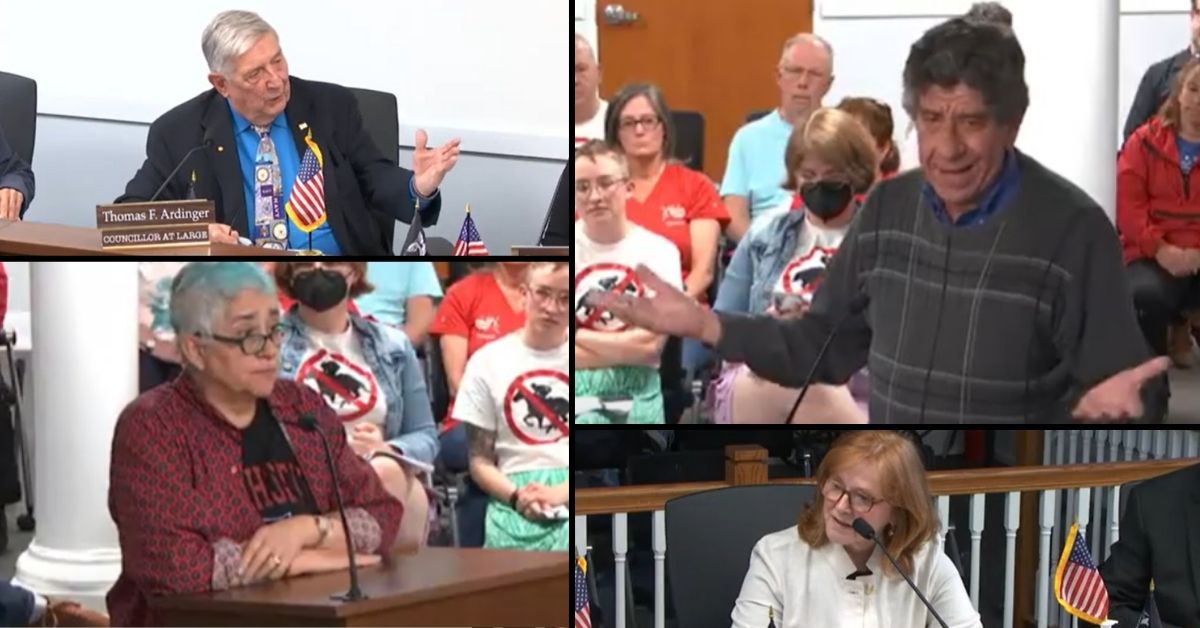
Photo credit: Screenshots via Leominster Access Television, YouTube
“Since the very beginning of this process, I have tried my hardest to get all the information out,” Mazzarella said. “No matter what it is, I’ve talked to hundreds of people. I fully understand the issue of gaming. Trust me, I get it. An abutter. I get it. I understand the treatment of animals. I don’t want to step on an ant. I get it. But one of my responsibilities as an elected officials is to make sure people get the information.”
Mazzarella said he’s worked “real hard” to share information with the public and that his stance on the petition depends on what that information ultimately reveals.
“But I’ve worked real hard, real hard to try to get the information out,” Mazzarella said. “And when it’s in favor of of the petition, I’m for it. If it’s against, then I’m against it.”
The city council’s special counsel for the matter, Jonathan Silverstein, likewise provided context during the meeting – stressing that Monday’s votes were not an approval of any final project but simply zoning measures.
“What’s before the council tonight is not approving a project, but rather determining whether or not that project can go forward to request approval,” Silverstein explained. If the Fairgrounds overlay were adopted, Silverstein said the developer would still need to return with detailed engineering, traffic, and environmental studies for permits.
Silverstein answered several community questions that had arisen. He confirmed the host agreement forbids racetrack traffic from using Mechanic Street, mandating “all access through the connector [road] only,” to protect residential areas. He also addressed the promised city payments, clarifying that “day one of the operation of the track the minimum payment – this is a floor, not a ceiling – would be $1.5 million in the first year.”
On the thorny issue of the landfill’s stability, Silverstein noted the track itself would lie atop the existing capped dump (essentially “thousands of tons of dirt” already in place) with no large permanent structures built directly on the refuse. The developer would still need oversight and approvals from state environmental regulators, he said.
And in a revealing clarification, Silverstein confirmed the racing aspect is largely a means to an end: under state law, hosting a few horse races enables the owners to obtain a lucrative sports betting license. Indeed, the plan calls for only “six races per year,” while “most of the sports wagering revenue is going to be from an online app.”
“So there is specific language about sports betting and revenue sharing from the sports betting, most of this revenue is going to be generated from people sitting at home not coming to the facility because having horse racing is the ticket that an applicant needs to be able to have a sports wagering license from the state,” Silverstein explained. “Everyone knows that’s the main thing. So, when we’re talking about the amount of traffic and the impacts of the project on the surrounding neighborhood, we’re talking about six races per year and most of the sports wagering revenue is going to be from an online app. So, it might be that the council still decides it doesn’t want to support this, and that’s fine. I just want to make sure you actually have facts and that you’re basing your decision on facts and not on misunderstandings.”
Councilors split on principle vs. project
When the issue came to the city council floor, councilors voiced differing philosophies even as most leaned against the racetrack. Ward 3 Councilor David Cormier supported the petition’s intent to explicitly outlaw racing, calling it a helpful clarification. “I have no problem with providing…clarity” in our ordinances, he said. “Obviously [horse racing] already is [prohibited],” since it’s not an allowed use, “and if somebody ever came in here with a proposal and there was an appetite for it by this body, it could be changed” by a future council.
Councilor At Large Thomas Ardinger was more blunt, suggesting the Fairgrounds debate had exposed a bait-and-switch. “I really think that this petition for all the horse racing is just a red herring…for the gambling,” Ardinger said. Initially he “vacillated” on the merits, seeing some potential “advantages to the city,” but “after hearing” the testimony that night, “my vote is solidified” against the racetrack, he noted.
Several councilors agreed the community’s will was unmistakable. “There’s no appetite for [horse racing] here in Leominster. I think [residents] have been clear and loud – they don’t want this in the town,” said Vice President and Ward 2 Councilor Pauline Cormier, urging colleagues to support the ban.
However, not everyone on the dais was comfortable outlawing a use citywide in advance. Longtime At Large Councilor Claire Freda cast the sole dissenting vote, explaining that her objection was procedural. “I have an issue with blanket voting on everything throughout the city and not dealing with [things] on the merits of an individual issue coming before us. So I don’t know that I can support this for that reason,” Freda said. She argued that if a particular proposal came forward, the council could judge it then, rather than preemptively slam the door. “We can vote everything down if we want to vote everything down,” Freda noted, pointing out that the building inspector already has authority to reject unlisted uses. She bristled at the notion that opposing the ban meant she didn’t “support the people of Leominster,” insisting “that’s absolutely not the case” – she simply favored case-by-case decision-making. In previous sessions, Freda and two colleagues had similarly voted against a blanket short-term rental ban, believing it unnecessary. This time, one of those colleagues flipped. Councilor At Large Brandon Robbins said while he also disliked the earlier blanket ban, in this instance, “I just don’t see any harm in putting this in [the books].” Adopting a racing prohibition could simply “be a statement about what we as people of Leominster believe in,” he said.
Ban passes 8–1, project faces uncertain future
After extensive debate, the council voted 8–1 to approve the horse-and-dog racing ban. Freda was the lone “nay” vote, standing by her procedural stance even as all eight of her colleagues voted “yes.” The supermajority easily cleared the two-thirds threshold required for zoning amendments. With that vote, Leominster’s zoning code will explicitly outlaw racetracks and wagering, bolstering what had been an implicit prohibition. Petition sponsor Lisa Nugent and supporters in the gallery applauded the outcome, which they hope will “insulate” the city from unwelcome gambling ventures going forward.
The newly adopted ban casts a long shadow over the separate “Fairgrounds” overlay zoning proposal, scheduled for a vote next. That plan — Petition 47-25 — sought to create a special district to allow the contested racetrack project at a waste-site off Mechanic Street. Not only did it require a supermajority approval, but a valid protest petition from more than 20% of abutters raised the threshold to seven out of nine council votes. Given that eight councilors had just voted to ban racing outright, the overlay district faced slim odds.
Indeed, the council ultimately voted 9–0 to deny Petition 47-25 during Monday night’s meeting, following a motion that recommended rejecting the overlay proposal. Council President Mark Bodanza clarified the vote structure, stating that a “Yay” vote would affirm the motion to deny the petition. All nine councilors voted in favor of the denial, formally halting the racetrack project in its tracks.
Any future attempt to revive the plan would now have to overcome the newly enacted racing ban — likely requiring fresh petitions or legal challenges.
For now, horse racing is off the table in Leominster. The council’s decision follows similar opposition in Gardner and other Massachusetts communities — including Hardwick, Sturbridge, and Wareham — where proposed horse racing developments between around 2020 and 2024 faced strong public backlash and were ultimately withdrawn or denied.
The city council’s next regular meeting is set for Monday, July 28, 2025.



This sounds like the last two nails are in the coffin on the fairgrounds/horse racing/betting. Curious if the developer will try and push this proposal through another way.
The coffin was indeed shut. However, “Dirty Dean” the Mayor of Leominster who has schemed and scammed and attempted to gaslight the community over and over into believing he’s ‘neutral’ — all while consistently providing a one-sided platform for the developers and attacking grassroots opposition as stoking misinformation and crying foul — is likely to attempt circumventing the will of the council and opposition majority by potentially pushing for a referendum and employing marketing tactics to manufacture support. But, that would likely be a nail in his political coffin.
It is nice to know that Leominster residents have voted for responsible leadership for their city. The city councilors have listened and recognized what the majority of the residents want and have acted accordingly. There are many communities wherein their elected officials, once in office, work towards their own personal agenda and vote strictly via their personal bias and prejudice. They use parliamentary regulations and restrictive procedural rulings, to make the will of the residents, unactionable. CONGRATULATIONS TO LEOMINSTER.