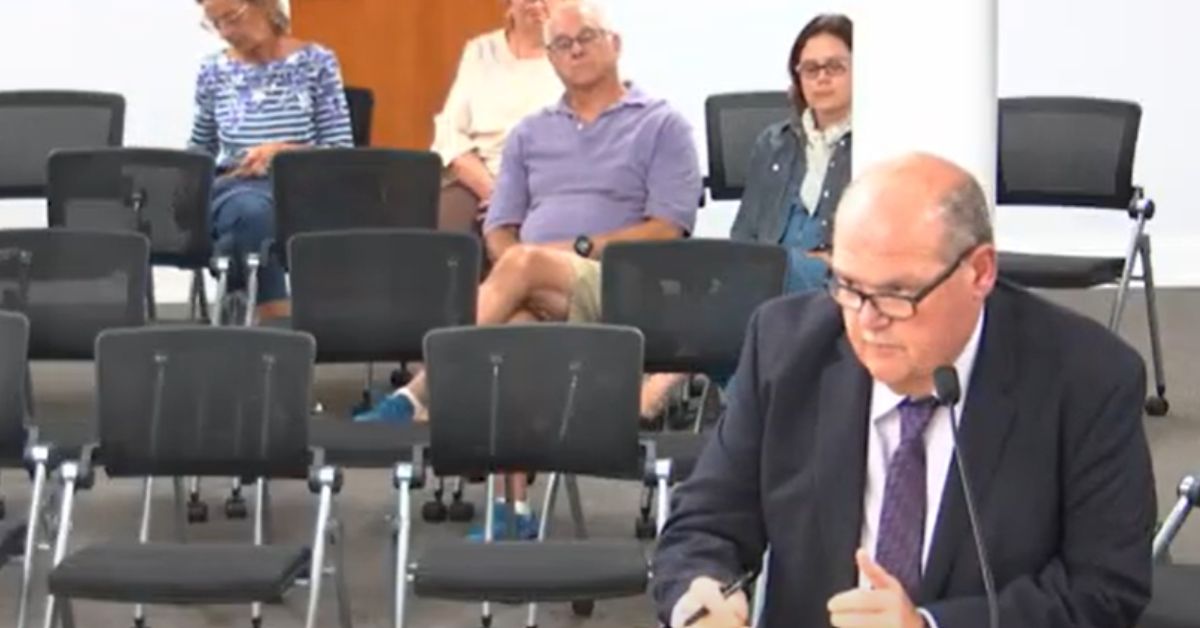
LEOMINSTER — A plan to construct 308 multifamily residential units within nine buildings on wooded land next to the Orchard Hill Park plaza was met with skepticism and concern during the July 21 planning board meeting, where residents and board members raised concerns about the development’s effects on traffic, emergency response, and the surrounding environment.
Presented by engineer Matt Bombeci of Bohler Engineering, representing the developer, WP East Acquisitions, the proposed multifamily project at 86 Orchard Hill Park Drive includes a clubhouse with amenities, a pool area for the residents, mailroom, and eight six-car garages with a total of 472 parking spaces. The approximately 18-acre development site, largely wooded and abutting wetlands in areas, is located directly west of the Orchard Hill Park retail plaza and borders residential streets such as Pioneer Drive and Harvard Street.
The current plan proposes two access points: a new connection to Harvard Street and an extension of Orchard Hill Park Drive. However, Planning Board Chair John Souza and residents questioned the project’s potential traffic impact, despite testimony from the city’s transportation peer review consultant, Jeffrey Dirk of Vanasse & Associates. During the meeting, Dirk clarified that while he did not conduct the independent study, his role was to evaluate whether the developer’s traffic study adhered to standard methodology and industry practices.
Dirk told the board that based on the study submitted by the applicant – which he said was prepared in accordance with standard practices – the added traffic would not significantly affect nearby roadways.
Dirk said that vehicles exiting Harvard Street can’t turn right, and entering traffic isn’t allowed to turn left, which effectively forces about 70% of trips onto Route 2 heading west toward Leominster.
“The amount of trips that they’re expecting the project’s going to produce is somewhere between 120 and 125 peak hour trips,” Dirk said. Dirk said those peak hour trip increases are expected to take place during a one-hour period from 7:00 a.m. and 9:00 a.m. when traffic is heaviest in the morning and between 4:00 p.m. and 6:00 p.m. when traffic is heaviest in the evening.
“That’s the amount of new traffic that they’re adding on to the roadway network,” Dirk said of the peak-hour trip estimates.
As for how the project would impact the delay in vehicle queuing at the intersections where the project is expected to add traffic, Dirk said the developer’s study indicates there’s sufficient capacity on the roadway to accommodate the additional traffic from the project.
“What they’ve shown in terms of net impact was delays didn’t go up by any more than 20 seconds at any particular intersection,” Dirk said, a statement that drew laughter and remarks from attendees. Souza responded, “This is on detail, done scientifically” and the audience laughed again. Dirk quickly continued over the quelling laughter, maintaining that while the developer’s study shows the project would only add up to 20 seconds of additional delay at any intersection, that doesn’t mean traffic is currently moving smoothly.

“The applicant has identified that there are movements that are operating over capacity,” he said, citing examples like long queues at the intersection of Mechanic Street and Harvard Street and difficult left turns from Old Union Turnpike after exiting Route 2. “It doesn’t mean it’s free-flowing conditions—and we all know that’s not the case,” Dirk said. Instead, the analysis measured the net impact of the project, or how much worse existing delays would become. “So, if you’re already waiting in a miserable long queue trying to get off Route 2,” he said, “what they’re saying is your wait in that queue will be no more than an additional 20 seconds in that queue. It doesn’t mean you’re going to get right off the highway without having to stop.”
Dirk said there’s a series of sign and pavement mark improvements, safety enhancements, and traffic signal retiming that the applicant is going to undertake that will add capacity to help offset the traffic impacts of the development.
“If there’s 15 vehicles waiting to get off of Route 2 onto the roadway, before and after the project, what they’re saying in their analysis is there’ll be 16 vehicles instead of 15 vehicles,” Dirk said. “That’s the measured impact of the project.”
During the public comment period, Haily Brady of 200 Harvard Street voiced concerns about the proposed 86 Orchard Hill Park Drive development, specifically its potential impact on nearby wetlands and the increase in traffic through her neighborhood.
“I’m sorry, but for the property taxes that we pay, can we have a little bit of peace without traffic,” Brady said. “And I know you did do some traffic analysis on…the entrance, but please drive up Harvard Street a little bit. I walked along it yesterday. You can’t widen the street. You can’t put sidewalks in. It’s scary. I can’t imagine you trying to walk with your kid—you can’t. Somebody is gonna get killed there. You can’t make it safer, and I think an increase in this traffic is just dangerous and irresponsible.”
Connor Byrne, who purchased the property at 284 Harvard Street in December, told city officials that two vernal pools exist on his land. He said he has already brought the matter to the attention of the city’s conservation commission and intended to submit documentation to the Massachusetts Natural Heritage and Endangered Species Program (NHESP). Over the weekend, Byrne said he discovered yellow-spotted salamanders, an endangered species, on his property.
“So, at 284 Harvard Street, there are two undocumented vernal pools on my property. One has standing water in early spring at five feet; the other has standing water in early spring at two feet,” Byrne said. “Both of these have been brought to the conservation commission, and I was going to submit this packet to Natural Heritage, but recently, this weekend, I found endangered species on the property—namely, yellow-spotted salamanders.”
Byrne said he sent photos of the salamanders to NHESP for identification and record-keeping.
“I believe further work is required in order to certainly say whether or not these nine apartment buildings will impact valuable wetlands and vernal pools which need to be protected and fall under the I think it’s MESA or the [Massachusetts] Endangered Species Act,” Byrne said. “There’s a couple of them in there. And I welcome your environmental people to come walk the property. I can show you exactly where they are.”
Byrne added that a conservation agent had visited his property and examined the vernal pools, stating that a species survey would be needed but could not be conducted until the spring.
“I welcome you,” Byrne said. Adding, “I mean, you look at the basin, it’s there. There’s a very clear muddy bottom wetlands and you’re planning on what? Having apartment buildings 15 feet from the stone wall? Are you kidding me? For shame.”
Kate Heinen, of 284 Harvard Street—which she said directly abuts the proposed development—asked a few clarifying questions to better understand the scope of the project.
“We did notice a yellow crane or something right in our backyard and we didn’t know what it was, so I guess one of my questions is will abutting residents be notified about important milestones in the future, about any other work being done,” Heinen said.
Souza responded saying, “The planning board would have that information on how they can progress, but traditionally, we haven’t, if someone requests something I think we could work out something.”
Heinen then asked, “If someone requests something can it be public knowledge?”
Souza responded saying that while the planning board oversees the site plan process, it must approve the project if it meets ordinance requirements, leaving environmental issues to the conservation commission and future oversight largely to the DPW.
Souza said during the meeting that the site plan still needs to be approved by the city’s conservation commission. Souza noted that conservation officials would weigh in on concerns related to wetlands and potential endangered species habitat, including reports of vernal pools and salamanders on abutting properties.
“Once a project is approved, and you have to remember, this project is site plan, we really have to eventually approve it almost in the ordinance of the city…say that if you meet certain requirements, you can in fact build on this property. We want to make sure it is built as best it can,” Souza said.
Following public testimony, the board voted to keep the hearing open and continue it to allow time for feedback from the conservation commission and for the developer to address concerns about parking, traffic, and other issues raised during the meeting.
The continuation was approved unanimously, with the next hearing scheduled for August 18 at 6:30 p.m.