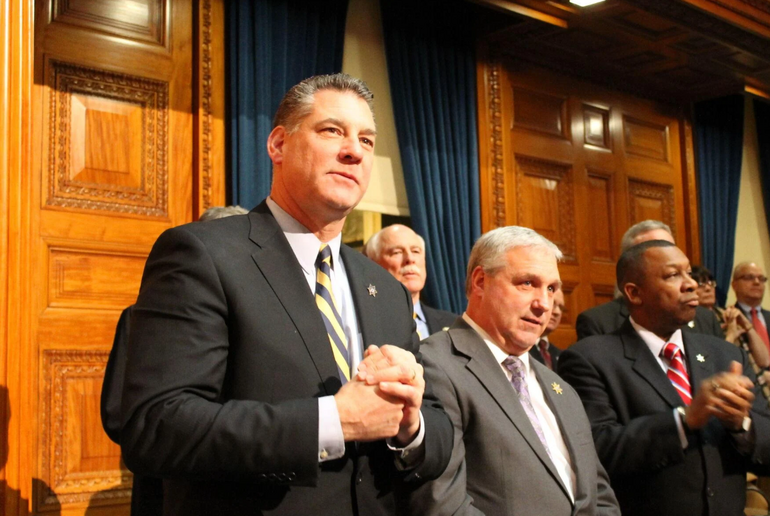
Bristol County Sheriff Paul Heroux says members of Congress have a constitutional responsibility to vote on whether the United States should continue military action against Iran following U.S.–Israeli strikes in the region that began Saturday.
Heroux — who has a master’s degree in international relations from the London School of Economics and has also spent significant time in the Middle East — made these comments as the U.S. Senate prepares to vote Wednesday, March 4, 2026, on a resolution invoking the War Powers Resolution of 1973, which would require congressional authorization for continued military operations.
The measure, S.J.Res. 104, introduced by U.S. Senator Tim Kaine (D – Virginia), directs the removal of United States armed forces from hostilities against Iran that have not been authorized by Congress.
The House of Representatives is expected to vote Thursday on a similar resolution, H.Con.Res.38, titled Directing the President pursuant to section 5(c) of the War Powers Resolution to remove United States Armed Forces from unauthorized hostilities in the Islamic Republic of Iran.
“The framers of the Constitution understood going to war was a big deal,” Heroux said. “They wanted a system where the people, through Congress, needed to authorize war.”
The War Powers Resolution of 1973, also known as the War Powers Act, was enacted on Nov. 7, 1973, over President Richard Nixon’s veto in response to the expansion of the Vietnam War into Cambodia and Laos without congressional approval. The law was intended to limit the president’s ability to commit U.S. forces to an armed conflict without authorization from Congress.
Under the War Powers Act, the president must notify Congress within 48 hours of introducing U.S. forces into hostilities and withdraw those forces within 60 to 90 days unless Congress authorizes a longer engagement.
The U.S. Constitution gives Congress the authority to declare war and fund the military under Article I, Section 8, while Article II, Section 2 designates the president as commander in chief of the armed forces. Presidents from both parties have ordered military operations without congressional approval, including Harry Truman’s decision to send U.S. forces into the Korean War in 1950 and Ronald Reagan’s 1983 invasion of Grenada.
Heroux said that even if the current resolution does not ultimately halt the conflict, members of Congress should still go on record.
“They should still do it because it is their job, so that the president is on notice, and so that we can see which members of Congress are for or against attacking Iran,” he said.
The resolution faces long odds in the now Republican-controlled Senate and House of Representatives, and is likely to be vetoed by Trump if it were to pass.
Heroux said he believes the issue reflects a broader problem in Congress, where members often fail to exercise their constitutional oversight responsibilities in deference to their political party or a president, adding that “members of Congress need to remember their oath is to the Constitution, not a party or a president.”
“The Constitution is not flawed. People are flawed,” Heroux said. “The process is a good process. The people who are supposed to hold the president accountable are not.”