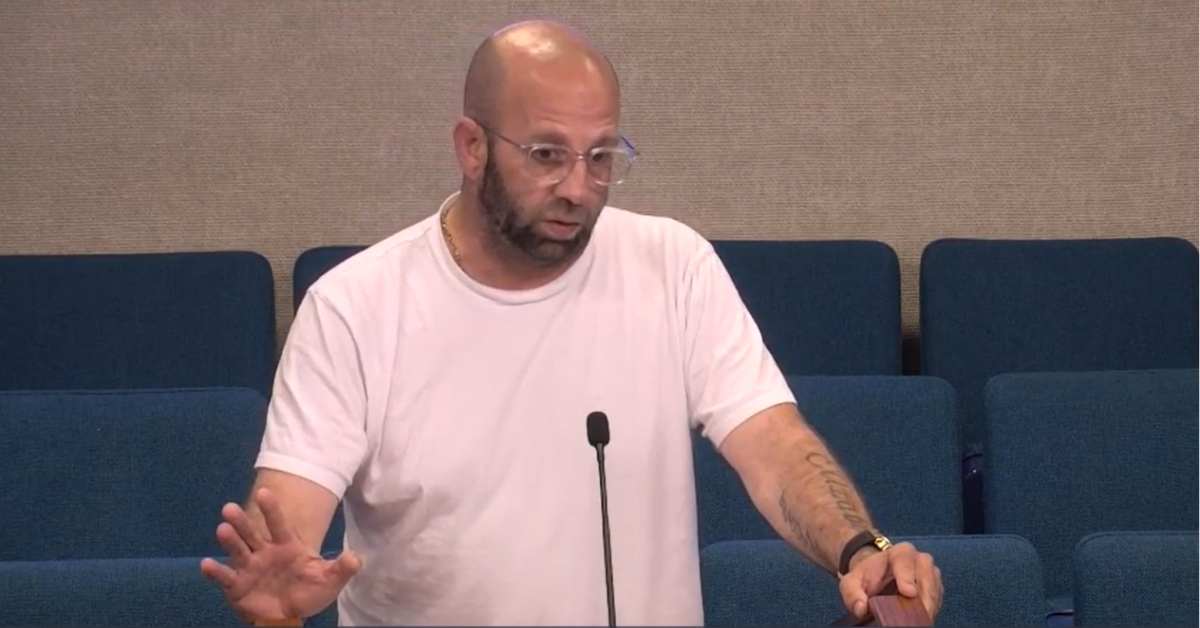
HAVERHILL — During its meeting on Tuesday, Aug. 11, 2026, the Haverhill City Council moved toward establishing a city ordinance governing the police department’s use of Flock cameras following a lengthy discussion during which councilors raised concerns about privacy, data sharing, and surveillance by both the government and private companies.
The issue was raised under agenda item 5.1, a communication from Mayor Melinda Barrett, who requested that Acting Deputy Police Chief Meaghan Pare appear to discuss Flock cameras and software used by the Haverhill Police Department for license plate monitoring.
During the meeting, Mayor Barrett said Haverhill has used Flock cameras since 2023. She said Deputy Chief Pare would explain how the technology works, the safeguards governing its use, and how it has assisted police with investigations.
Deputy Chief Pare said the city has 19 cameras positioned near entry and exit points. She explained that when a vehicle passes a Flock camera, it takes a picture of the license plate, and obtains the plate number of the vehicle, the state of the vehicle, its color, and any identifying markings, such as a sticker or roof rack.
“Flock provides information about vehicles, not people,” Deputy Chief Pare added. “What Flock does not do, Flock is not facial recognition.”
Deputy Chief Pare said Flock does not identify drivers, provide criminal histories, or replace traditional investigative work. She said police can use the system to identify vehicles, establish timelines, connect incidents and develop investigative leads.
According to Deputy Chief Pare, the cameras have assisted investigations involving homicides, shootings, armed robberies, domestic violence, stalking, drug trafficking, stolen vehicles, sex offender investigations, criminal harassment, stolen vehicles and plates, hit-and-run crashes, animal cruelty, and other offenses.
Deputy Chief Pare said Flock information alone does not identify a vehicle’s registered owner. Officers must enter the license plate into a separate criminal justice database, such as Criminal Justice Information Services (CJIS), which is run by the state, to obtain the registered owner and other identifying information.
The Haverhill Police Department conducts quarterly audits of the Flock system, Deputy Chief Pare said. Its audit history shows who searched for a plate, when the search was conducted and the reason provided for it. She told the council there has been no confirmed misuse of the system by Haverhill police officers.
“We don’t share with federal agencies and we don’t utilize this for immigration purposes ever,” Deputy Chief Pare said, adding that the restriction is included in the department’s policies and procedures.
Council Vice President John Michitson then stated, “The idea, though, that you could track somebody that wasn’t a criminal, right, across the region, I mean, that’s not a good thing in a lot of people’s minds.”
Deputy Chief Pare replied that the purpose of the cameras is not to track people who haven’t committed crimes, but to investigate crimes that have been committed.
Councilor Ralph Basiliere then said that, after reviewing about 20 peer-reviewed legal articles on the issue, he found that potential civil liberties violations involving license plate readers remain the subject of ongoing legal and ethical debate. He noted that the American Civil Liberties Union characterizes the technology as warrantless tracking and that the Electronic Frontier Foundation argues it threatens Fourth Amendment protections. However, Basiliere said courts have generally found no reasonable expectation of privacy in license plates displayed on public roads. He supported using the cameras as a lawful and effective public-safety tool unless the U.S. Supreme Court rules otherwise, while emphasizing that he remained sensitive to potential civil liberties violations.
“The bottom line for me, as a city councilor who’s promised to keep people safe, is that they’re an effective and lawful tool to keep us safe until such time that the Supreme Court rules otherwise,” Councilor Basiliere said. “I’m in favor of their use. I’m very sensitive to civil liberties violations.”
Trevor Chandler, senior director of public affairs for Flock Safety who participated in the meeting remotely, said the company does not sell customer data and that Haverhill owns its information and controls which agencies may access it.
“We have specific enumerated lines in the contract that allow us to access data in a limited fashion to help support the tool’s operation, as with most contracts you have,” Chandler said. “But Flock does not own the data. You do. We do not sell data.”
Councilor Melissa Lewandowski noted that although the police department has policies governing the technology, the city does not have an ordinance regulating its use. She then made a motion to ask the city solicitor to work with police to establish an ordinance addressing prohibited uses, access and data retention, which was quickly seconded.
Councilor Lewandowski said the central issue was not simply whether the technology constituted mass surveillance, but whether it enabled the suspicionless tracking of the public.
“We’re talking about a safety tool versus privacy risk,” Lewandowski said. “We want to maximize safety. We want to minimize any civil liberty violation. I, too, am sensitive to the civil liberties argument about surveillance. Nobody likes that. Nobody likes a broad reach of government, you know, looking through your window or looking through your car’s window, right?”
Councilor Lewandowski said approximately 30 court decisions have found the technology constitutionally valid, reflecting the current state of the law. She added that the Fourth Amendment protects a reasonable expectation of privacy, but no such expectation exists on public streets.
Councilor Lewandowski then stated that the purpose of the cameras is to record license plates to help law enforcement solve crimes, including firearms offenses and cases involving sex offenders who fail to register. She added that Haverhill’s Flock cameras have helped solve at least 12 crimes “of a significant nature.”
“I don’t think that anybody in this room who is opposed to these for civil liberties reasons would argue that we don’t have actual data that shows that this technology solves crimes,” Councilor Lewandowski said. “Again, full stop. It does.”
When Councilor Devan Ferreira said that, unlike her colleagues, she did not support the cameras despite recognizing their value as an investigative tool, the audience erupted in applause.
“It is an AI platform that’s gathering our data, that is building an algorithm that is then informing our case work here,” Councilor Ferreira said. “So, it’s building our hot lists that can go from town to town. If something’s happening in Methuen and the car’s coming our way, all this part of the services that Flock provides is exactly that. It’s an aggregation of data on a larger level, and we don’t really know what that gets used for, even if it becomes anonymous.”
Councilor Ferreira expressed concern that Flock aggregates data on a broader scale and that city officials do not know how the information is used, even after it is anonymized. As a hypothetical example, she raised the possibility that the company could use the information to evaluate local traffic patterns, such as the number of black sedans traveling on Main Street every day, and asked if the resulting data could characterize the roads in the city as unsafe and ultimately affect Haverhill’s automobile insurance rates.
“By giving access to this company, even to collect our aggregate anonymous data, we are giving a private corporation access to how our community operates, what happens here, what people are doing, where our heavily traveled roads are, and how people come and go from the city,” Councilor Ferreira said. “I’m not comfortable with that.”
At the end of their discussion, the council voted unanimously, 11-0, to send a letter to the city solicitor to establish an ordinance to include guardrails for the use of Flock cameras in the city.
The council then voted 10-1 to send the issue to the Public Safety Subcommittee for further discussion, with a recommendation to be returned to the city council. Councilor Lewandowski cast the sole opposing vote.