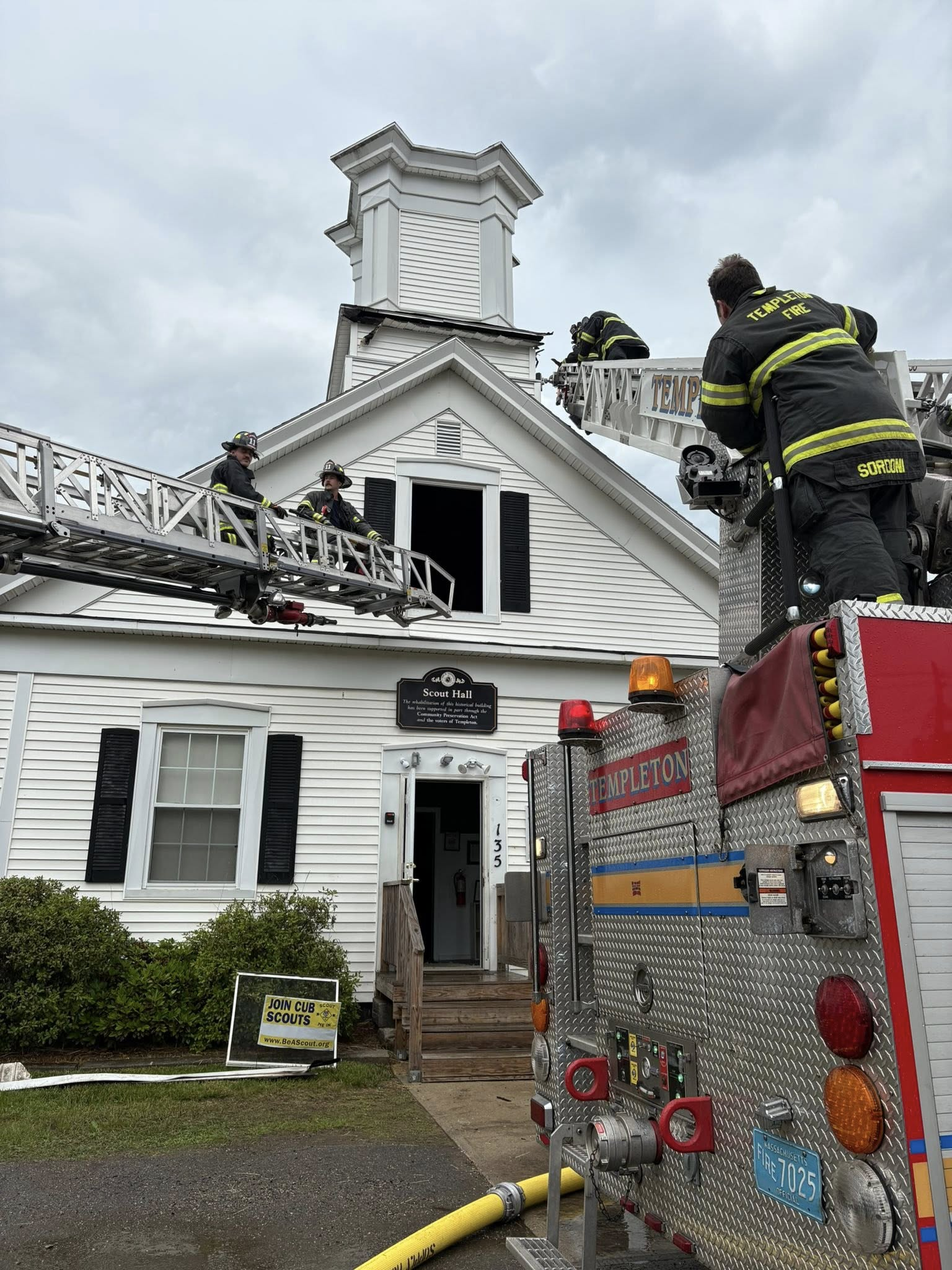
TEMPLETON — During its meeting on Wednesday, June 25, 2025, the Templeton Select Board voted unanimously to preserve the historic cupola atop Scout Hall, siding with residents and historical advocates despite concerns about aesthetics and structural costs.
“I just can’t support taking the cupola off,” said Select Board member Candace Graves. “That cupola stands for the history of all those children that came into that classroom all those years ago.”
Scout Hall, located at 135 Patriots Road in East Templeton, was originally built in 1834 as Templeton’s first schoolhouse, serving the East Templeton district as a one-room educational facility. Later, it served as a meeting hall for Cub and Boy Scouts and briefly housed the Council on Aging before volunteers, backed by Community Preservation Act funds, restored it. Today, the historic white‑clapboard building functions as Templeton’s Scout Hall & Visitors Center, hosting youth troop meetings, community gatherings, and serving as a welcoming point for residents and visitors.

Public Services Director Bob Szocik had recommended removing the cupola, describing it as a heat loss, water trap, and aesthetic outlier.
“In my opinion, I don’t think it’s that aesthetically pleasing,” Szocik said. “It’s just a couple of square boxes.”
Historical Commissioner Mike Dixon acknowledged the building isn’t formally protected at the state or federal level but advised the board to keep the cupola in place if feasible.
“The Historical Commission would recommend that we preserve the cupola if we can—if it’s feasible,” Dixon said. “It’s a very historic building, as such, and it would be great to keep it that way.”
Scout Hall is currently undergoing insurance-funded remediation following significant water damage and mold discovered in the attic and ceiling. Szocik said all of the insulation had been removed from the attic and the basement and portions of the ceiling in the lobby of Scout Hall had to be removed due to mold. The building’s main hardwood floor was also dried out, and a new hot water heater and new electrical breakers were also installed. The town has an active insurance claim, and Szocik noted that he had submitted the first three invoices for reimbursement. Szocik estimated it could be about a month and a half before the next phase of the restorative project can even be quoted or put out to bid.

Although a lightning strike ignited a fire in the building’s cupola on June 6, 2025, prompting a multi-town fire response, Szocik said the current remediation includes both fire-related damage and separate issues involving mold, water infiltration, and rotted boards.
“From what they have from the fire damage, we are still going to [need to] come down the road [and make] some other repairs due to the boards being rotted,” Szocik explained.
Following discussion, the board voted unanimously to instruct Public Services Director Bob Szocik to proceed with repairs and keep the cupola on Scout Hall.
Audit raises red flags
The meeting also included the town’s annual financial audit presentation for fiscal year 2024 by Tony Roselli, managing partner of Roselli, Clark & Associates. Roselli outlined several ongoing issues, including underperformance in town investments and an unresolved discrepancy in budget certification.
“You should be earning about $300,000 in the general fund just on interest,” Roselli said, adding that there’s $2.6 million in the town’s general fund and $2.2 million in investments—an amount that, at a 5% interest rate, could generate roughly $300,000 in earnings. “It’s still a little bit on the low side, but the town is starting to take better advantage of the interest income that’s available to them.”
Roselli also noted a $112,000 discrepancy between the town’s tax recap and its budget workpapers for fiscal year 2024 — a difference that his team at Roselli, Clark & Associates could not reconcile because, he said, “there was so much turnover, no one was able to do that for us.”
“It could be okay that there was a variance, but we were unable to satisfy ourselves why that variance existed,” Roselli said.
Rosselli then warned the board about rising cybersecurity threats, including phishing attacks and wire fraud schemes that have affected other municipalities. “There’s just been a lot of really stupid things happening with imposters pretending to be contractors saying, ‘Hey, can you wire us $300,000 for the work that we did,’” he said, referencing cases in which town staff mistakenly wired large sums of money to fraudsters posing as contractors.
Roselli recommended employee training to recognize suspicious emails and suggested using dummy phishing tests to identify areas needing improvement. He also raised concerns about cash-handling procedures in smaller departments, urging stronger internal controls and better safeguarding of assets.
Advisory Committee outlines PILOT gap, calls for select board support
During the meeting, Advisory Committee Chair Nowell Francis raised concerns about the financial impact of state funding formulas on Templeton, particularly under the Payment in Lieu of Taxes (PILOT) program for state-owned land. Francis said that, according to a report from State Auditor Diana DiZoglio, Templeton has 2,579 acres of state-owned land. For fiscal year 2024, the town received $154,381 in PILOT reimbursements—equating to about $60 per acre. Francis noted that the statewide median reimbursement is $127 per acre, and if Templeton were reimbursed at that rate, the town would have received $327,533.
“It would have been more than double what we currently receive,” Francis said.
Francis noted that State Senator Joanne Comerford, who represents the Hampshire, Franklin, and Worcester District, has filed legislation (S.1939) that would raise all PILOT reimbursements throughout the Commonwealth to at least the statewide median of $127 per acre. He added that the Advisory Committee plans to submit a formal recommendation on the issue after its next meeting, requesting the board’s support.
“There will be a recommendation from our next meeting on this issue of PILOT, using these figures,” Francis said. “I hope that you’ll give it serious consideration at that time. It will be a written recommendation.”
He also reminded the board of a previous Advisory Committee recommendation to write a letter to Boston Mayor Michelle Wu requesting at least $500,000 in reimbursement, referencing a PILOT formula proposed by the City of Boston that suggests $100,000 in payments per 1% of state-owned land. Under that approach, Francis said, Templeton—which has roughly 6% of its land owned by the state—should receive closer to $600,000 annually.
No formal action was taken, but the topic is expected to return for further discussion once the Advisory Committee submits its written recommendation.